
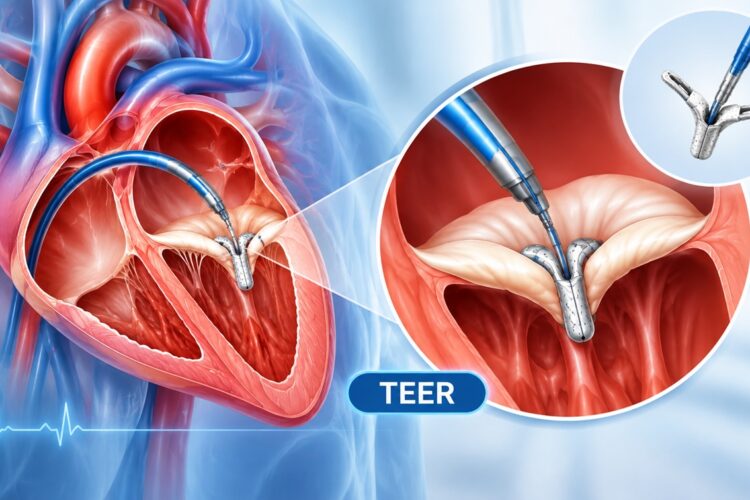
Transcatheter Edge-to-Edge Repair (TEER) with MitraClip
A minimally invasive treatment for a leaking mitral valve
The mitral valve is one of the four valves of the heart. It allows blood to flow in the correct direction from the upper chamber to the lower chamber of the heart.
Sometimes, the mitral valve does not close properly. Blood then leaks backward instead of moving forward. This condition is called mitral regurgitation (MR), or a leaky mitral valve.
When the leakage is significant, a person may develop breathlessness, tiredness, reduced ability to walk or exercise, swelling of the legs, or repeated hospital admissions due to heart failure.
What is TEER?
TEER stands for Transcatheter Edge-to-Edge Repair.
It is a minimally invasive procedure that can repair a leaking mitral valve without opening the chest.
One of the most widely used devices for this treatment is the MitraClip™ system.
The basic idea is simple: a small clip is placed on the mitral valve leaflets and gently brings them together. This reduces the gap through which blood is leaking and helps the valve close better.
How is MitraClip performed?
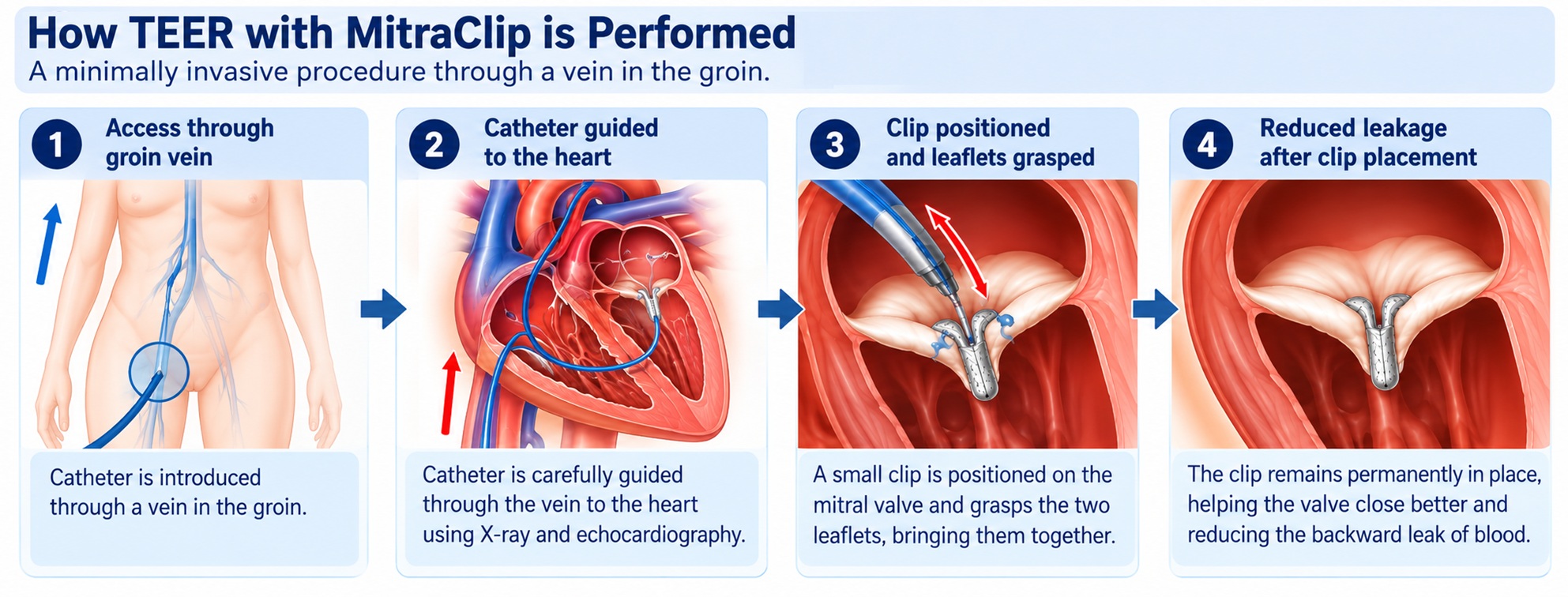
- A thin tube called a catheter is introduced through a vein in the groin.
- The catheter is carefully guided to the heart.
- Using continuous echocardiography and X-ray imaging, the doctor positions the clip at the mitral valve.
- The clip grasps the two mitral valve leaflets and brings them together.
- The doctor checks how much the leakage has reduced and confirms that the valve is working properly.
- The clip is then released and remains permanently attached to the valve.
The procedure is performed through a blood vessel rather than through open-heart surgery. A heart-lung bypass machine is generally not required for the TEER procedure.
Who may benefit from TEER?
TEER is not required for every patient with mitral regurgitation.
It may be considered for carefully selected patients with significant, symptomatic mitral regurgitation, particularly when:
- The patient has significant symptoms despite appropriate medical treatment.
- The mitral valve anatomy is suitable for clipping.
- Open-heart surgery carries a high or prohibitive risk in some patients with primary (degenerative) MR.
- In selected patients with secondary (functional) MR, symptoms and significant leakage continue despite appropriate heart-failure treatment.
A multidisciplinary Heart Team, including specialists in valve disease, heart failure and cardiac surgery, evaluates each patient before deciding whether TEER is appropriate.
What are the possible benefits?
For appropriately selected patients, reducing mitral valve leakage may:
- Improve breathlessness and other symptoms
- Improve the ability to perform daily activities
- Improve quality of life
- Reduce the burden of heart failure and, in appropriate patients, reduce hospitalizations
The goal is to reduce the backward leakage of blood and help the heart work more efficiently.
Is TEER safe?
TEER is a minimally invasive procedure, but it is still a heart procedure and is not risk-free.
Possible complications include bleeding or problems at the groin access site, infection, abnormal heart rhythm, blood clots or stroke, injury to the heart or surrounding structures, residual or recurrent mitral leakage, narrowing of the mitral valve, and, rarely, the need for additional treatment or surgery.
TEER or surgery?
For some patients, surgical mitral valve repair remains the preferred treatment, particularly when surgery can be performed safely and a durable repair is expected.
For other patients, especially those at high surgical risk or those meeting specific criteria for TEER, a catheter-based repair may provide an important less-invasive treatment option.
The right treatment depends on the patient’s symptoms, age, overall health, type and severity of mitral regurgitation, valve anatomy, heart function and surgical risk.
The key message
A leaking mitral valve should not be ignored.
Modern treatments such as TEER with MitraClip can offer a minimally invasive treatment option for selected patients with significant mitral regurgitation.
If you or a family member has been diagnosed with a leaking mitral valve, discuss the condition with a cardiologist or Heart Valve Team to understand whether medicines, surgery, TEER, or another treatment is most appropriate.
Every heart is different. Get evaluated to find the right treatment for you. Speak with a cardiologist or heart team to understand which treatment is most appropriate.
Looking for a TEER specialist in Ahmedabad? Get in touch now.
Image Credits: All images are generated by ChatGPT AI and is for representational purpose only.